
Claude Setup Interior Designers
By Zeel Jain
Most of the work that eats your weekend isn't design. It's the brief, the report, the proposal, the Friday update. The stuff your taste doesn't actually touch. This is the setup that hands all of it to Claude, without losing your voice or your judgment. None of it needs a tech person. None of it needs 'AI training.' It just needs the folder structure on the next page and the prompts at the end of this document.
FOR INTERIOR DESIGNERS
The Claude Setup.
Folder structure, four workflows, four prompts. Set it up once, runs the next ten projects.
Most of the work that eats your weekend isn't design. It's the brief, the report, the proposal, theFriday update. The stuff your taste doesn't actually touch.
This is the setup that hands all of it to Claude, without losing your voice or your judgment. None of it needs a tech person. None of it needs 'AI training.' It just needs the folder structure on the next page and the prompts at the end of this document.
STEP 01
The folder structure.
Set this up once per project. Cowork (and Claude in general) work best when they can read a clean folder. Messy drives produce messy outputs; give it structure and it gives you back exactly what you need.
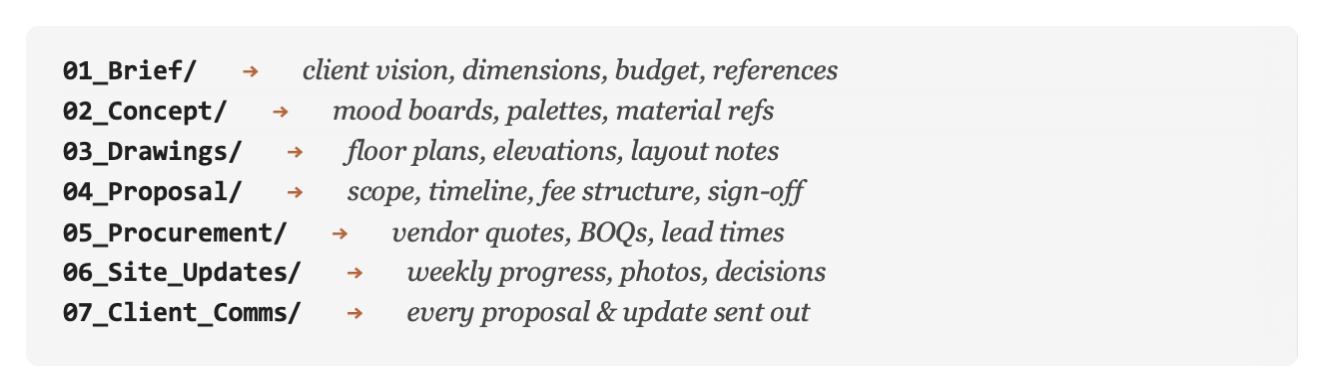
That's it. Seven folders. Use the same structure across every project so the prompts below run the same way every time.
STEP 02
The four workflows.
These are the highest-ROI tasks to hand off first. Each one used to take half a day. Each one now takes about ten minutes once the prompt is set.
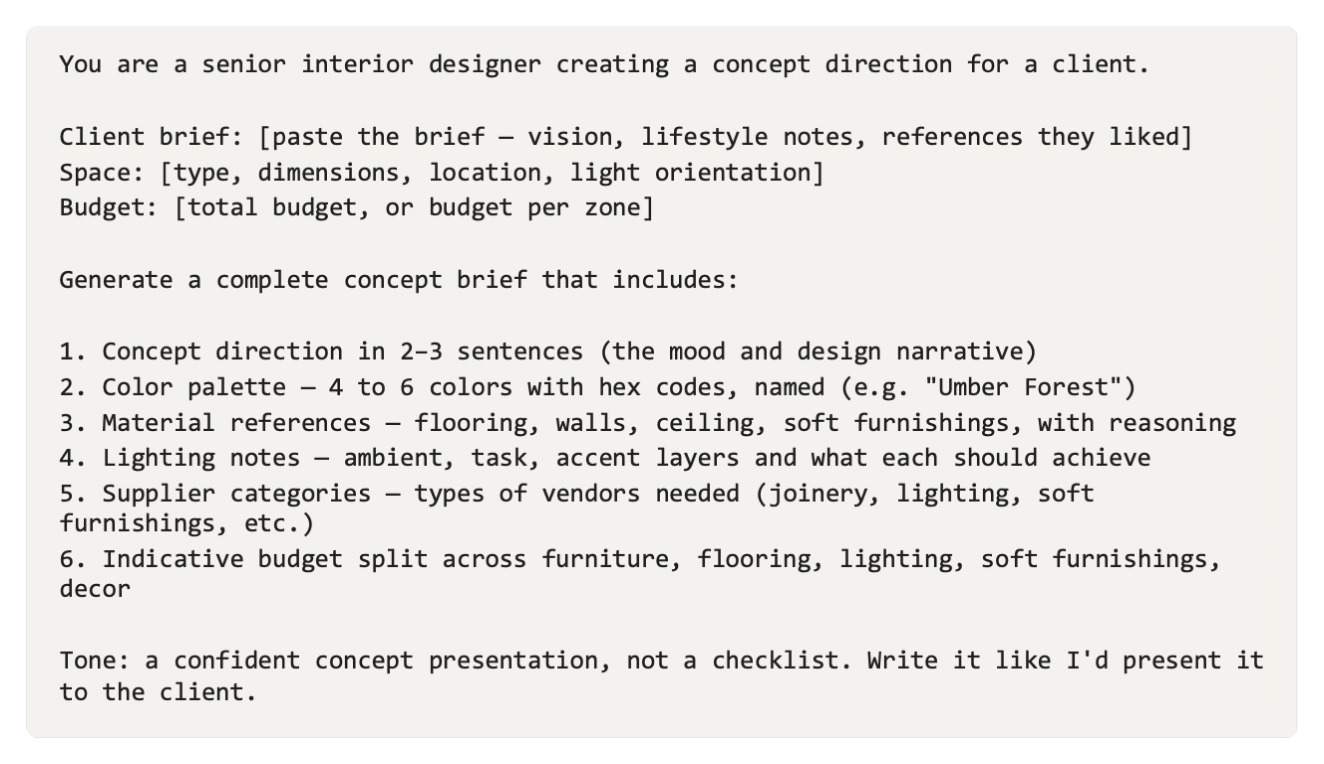
01 · Mood board + concept brief
WHEN TO RUN IT
After the first client meeting, before you touch InDesign or Figma.
WHAT TO FEED IT
The client brief, space dimensions and orientation, total budget.
WHAT YOU GET BACK
Color palette with hex codes, material references, lighting layers, supplier categories, indicative budget split. Ready to hand to your team or present directly.
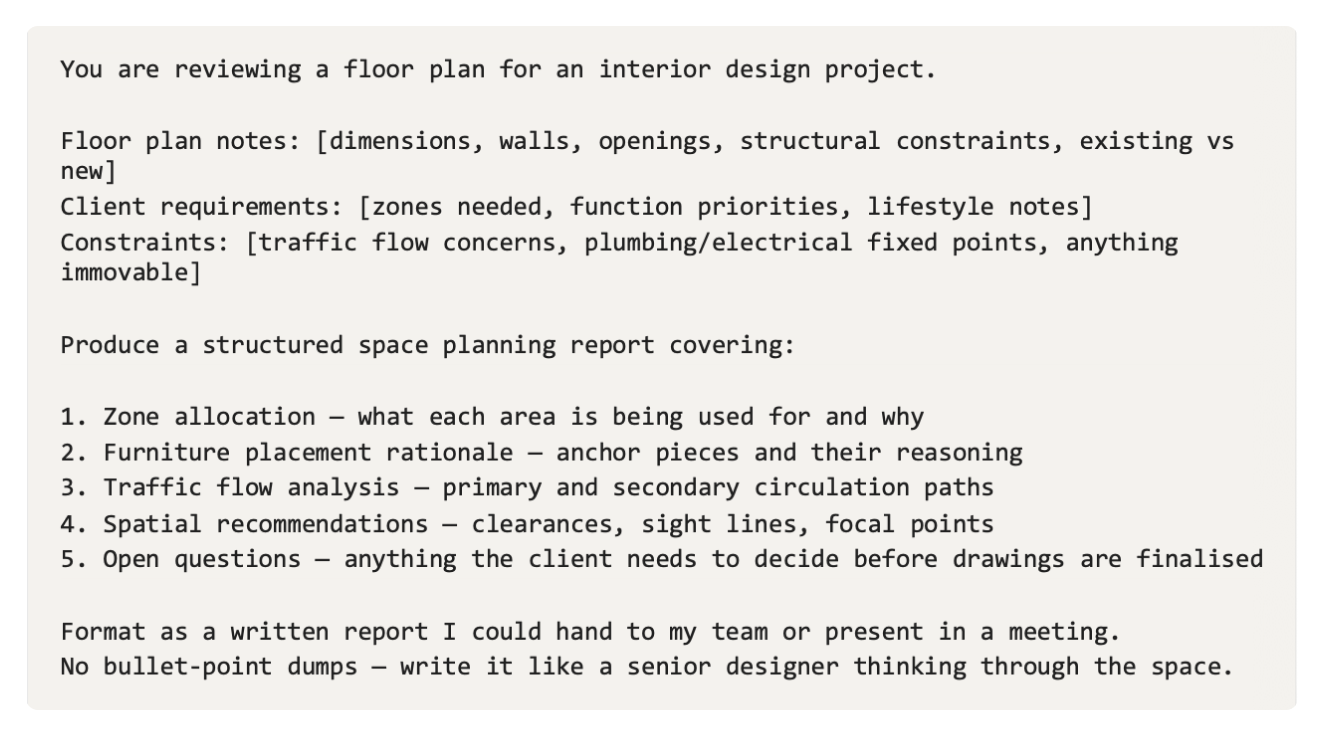
02 · Space planning report
WHEN TO RUN IT
Once your floor plan is locked but before drawings go to the team.
WHAT TO FEED IT
Floor plan notes: dimensions, walls, openings, fixed points, what's existing vs new.
WHAT YOU GET BACK
A written report with zone allocation, furniture placement rationale, traffic flow analysis, and the open questions still blocking the brief. The format you'd normally spend two hours writing.
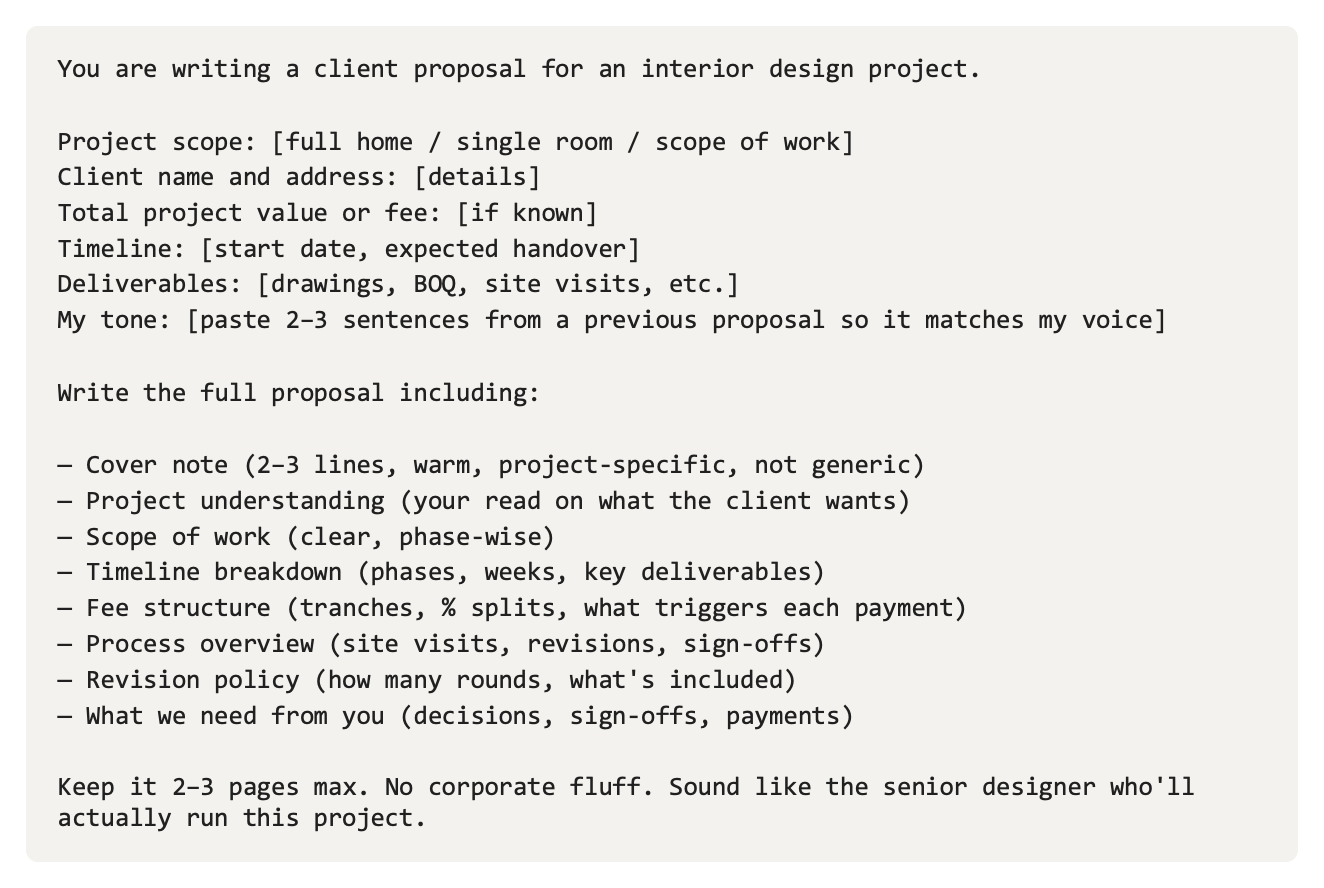
03 · Client proposal in 10 minutes
WHEN TO RUN IT
After the client says yes verbally, before they cool off.
WHAT TO FEED IT
Project scope, fee, timeline, deliverables, and 2–3 sentences from an old proposal so the voice carries over.
WHAT YOU GET BACK
The full proposal: cover note, scope, phase-wise timeline, fee tranches, revision policy, what you need from them. In your tone. 2–3 pages.
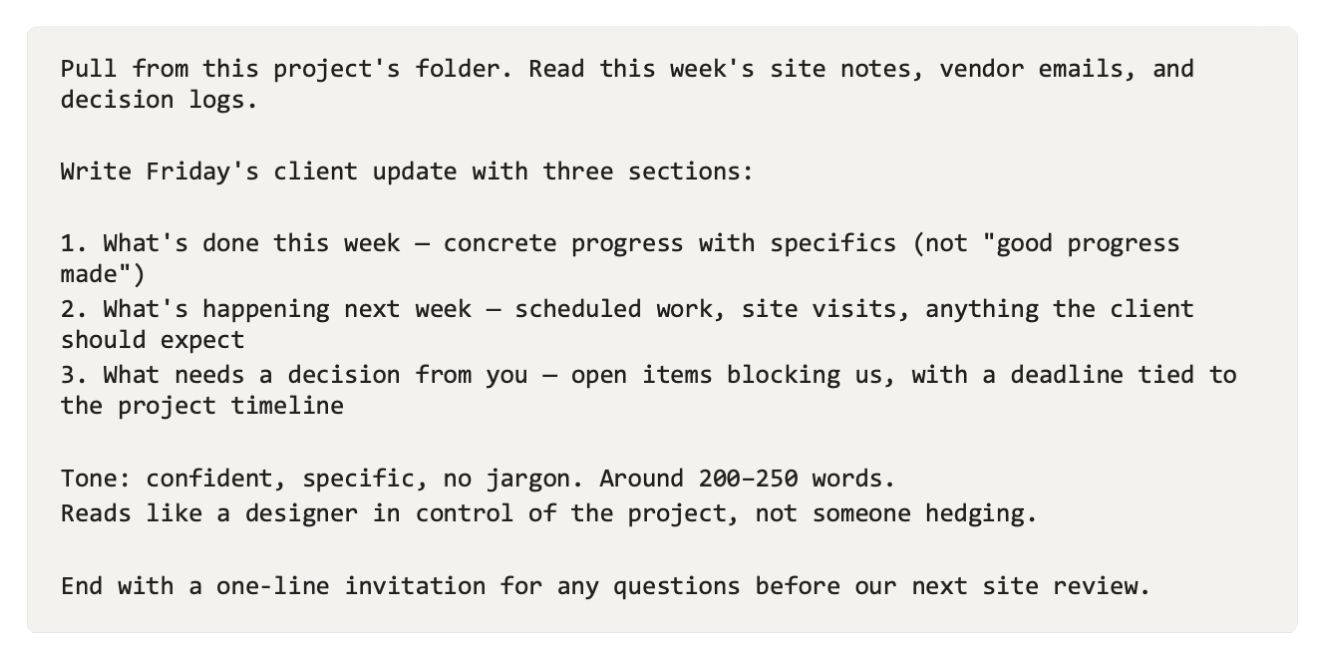
04 · Weekly client update · Cowork
WHEN TO RUN IT
Friday morning. Before the Monday meeting. Connect Cowork to your project folder once.
WHAT TO FEED IT
Nothing, the prompt does the reading. Cowork pulls site notes, vendor emails, and decision logs straight from the project folder.
WHAT YOU GET BACK
A structured update: what's done, what's next, what needs a decision from the client. 200–250 words. Sent before the client even asks.
ONR LAST THING
Your taste is the value.
Clients aren't paying you to write proposals. They're paying for the read on the space, the material call, the room they couldn't have imagined themselves. That's the work that needs your hands on it.
Everything else, the brief, the report, the proposal, the Friday update - is admin in a nicer outfit. Hand it over. Get the weekend back.
If you set this up and one of the prompts doesn't quite fit your studio's voice, tell Claude. Paste a previous version of how you'd write it. It'll match. That's the part that scales, not the prompt itself, but how easily you can teach it your voice.