Think by Hand
By Zeel Jain
FIELD GUIDE - THINKING BY HAND
When to put the phone down and pick up the pen.
AI is doing more of the thinking now. This is a small, deliberate practice for keeping some of it yours: four moments each week to write by hand, and what to put on the page.
4
Moments in the week
~30 min
A day, total
0
Notebook and 1 pen
Writing by hand is the last place you cannot outsource the thought.
AI is incredible at doing things for you. That is exactly the problem when the thing it is doing is your thinking. The replies you do not compose yourself, the decisions you do not draft yourself, and the ideas you do not develop yourself do not disappear. They become faster and emptier.
Scrolling feels like learning. Prompting feels like deciding. Neither is. Both leave you with the texture of completed work and almost none of the residue: the half-formed second thought, the line you crossed out, or the question that turned out to be the real one.
Writing by hand brings the friction back. It is slow on purpose. You cannot autocomplete a sentence you have not thought of yet, and you cannot fake clarity in your own handwriting. That is the feature, not the bug
The trade isn't AI vs. no AI: It's which thoughts do I want to keep min? The page is hwere you draw that line - four times a week is enough.
MOMENT 01 · REPLY
Draft the first version on paper, not the screen.
Before any reply you would otherwise write with AI.
The bot-to-bot loop starts here. Someone writes a post with AI. The algorithm sends it to you. You ask AI to reply thoughtfully. They receive the notification and use AI to reply. Neither of you had the thought, and neither of you read the exchange properly. Two language models are talking through two phones.
The shortcut: give any reply that matters more than the next one a sixty-second handwritten pass. Write two or three lines about what you actually want to say, in your own words, before you touch the keyboard. Then go to the screen. Use AI to tighten the message, never to invent it.
The notebook stays open beside the laptop. The act is small enough that you'll keep doing. The output is short enough that you cannot fake it.
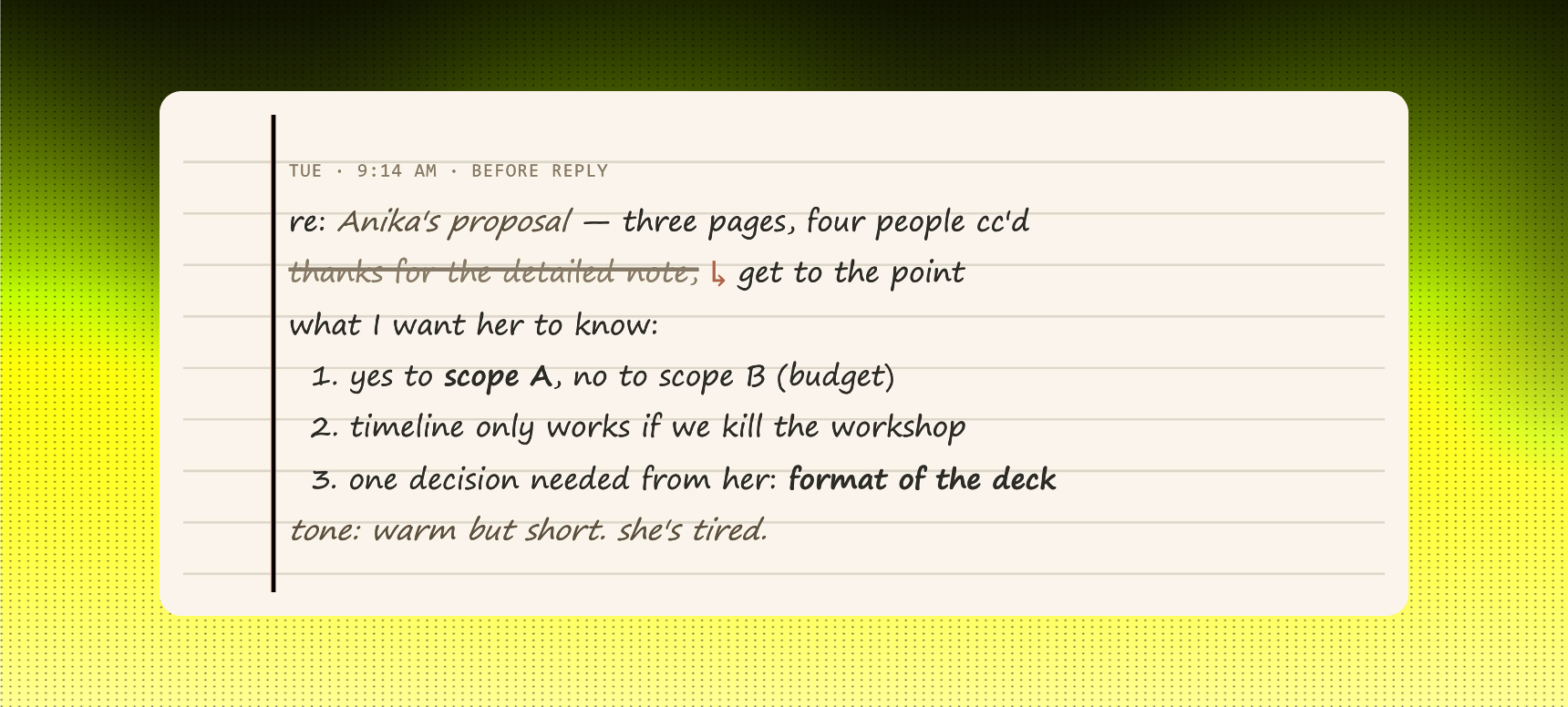
Example: A REPLY TO A LONG CLIENT EMAIL
You ask yourself: "Before I open the laptop, what do I actually want this person to know?"
STRENGTHS
- It ends the bot-to-bot loop in messages that matter.
- Your voice survives the AI polish because the thought was yours first.
- It is faster than rewriting an AI draft that did not express what you meant.
LIMITS
- It does not scale to a 200-message inbox. Choose what counts.
- It can be awkward between back-to-back meetings. Keep the notebook within reach.
- Some replies are genuinely boilerplate. Do not moralize the routine ones.
Use this when: the reply will be remembered, forwarded, or referenced later, including proposals, hiring messages, difficult conversations, and posts under your name.
MOMENT 02 · DECIDE
Write both sides out by hand before asking anyone.
When you would otherwise prompt your way to certainty.
It is tempting to place a difficult decision in a chat window and ask for a recommendation. The answer comes back balanced, persuasive, and not yours. You may act on it, yet six months later you will not remember why you decided. That is the cost: losing the trail of your own reasoning.
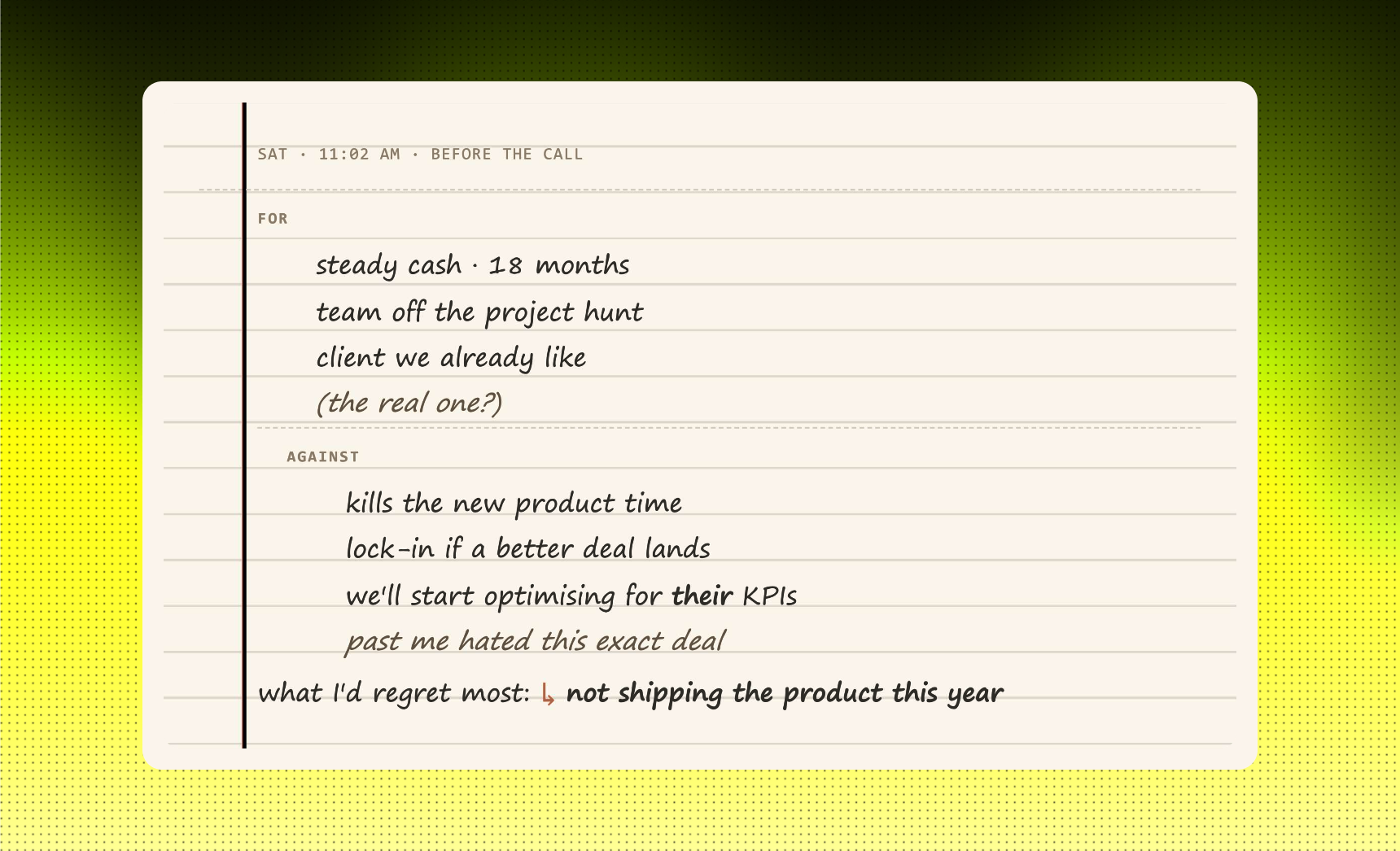
The shortcut: draw two columns on a blank page. Put reasons for the decision on the left and reasons against it on the right. At the bottom, answer: "What would I regret most?" Only then should you talk to AI, your partner, or an adviser. Their input lands on top of a position you already have rather than replacing it.
The page surfaces the real driver. Often the "for" column contains one good reason and three rationalizations. That is the decision you came to make.
Example: SHOULD I TAKE THE RETAINER OFFER?
You ask yourself: "What is actually pulling me in each direction, before I let anyone else weigh in?"
STRENGTHS
- It surfaces the real driver, which is usually buried under several polite reasons.
- You cannot fake clarity in your own handwriting; the weak case looks weak.
- Months later, you can read the page and remember why you chose.
LIMITS
- It is slower than asking AI for a recommendation. Slower is the point.
- It does not replace expert input on technical or legal questions.
- It does not help if you have already decided and are only looking for permission.
Use this when: the decision will still shape your week three months from now, including hires, partnerships, pricing, and projects you accept or decline.
MOMENT 03 · POST
Hand-write the post in one paragraph. Then format.
If you would not say it aloud, do not post it.
Much of the thought leadership online is two language models and a template. The cadence is right, the takeaways are tidy, and the hook works, but the post says nothing only the author could have said. Readers feel the absence and scroll past. The algorithm notices.
The shortcut: start every post under your name as a single handwritten paragraph in a notebook. Do not begin with the hook or the bullet list. Write the entire idea in your own words before opening a screen. Then move it to the keyboard. AI can help you tighten and format the thought, but it should not generate it.
You will write fewer posts. The ones you publish will be unmistakably yours. That is the same trade every long-running writer makes: fewer pieces, more signal.
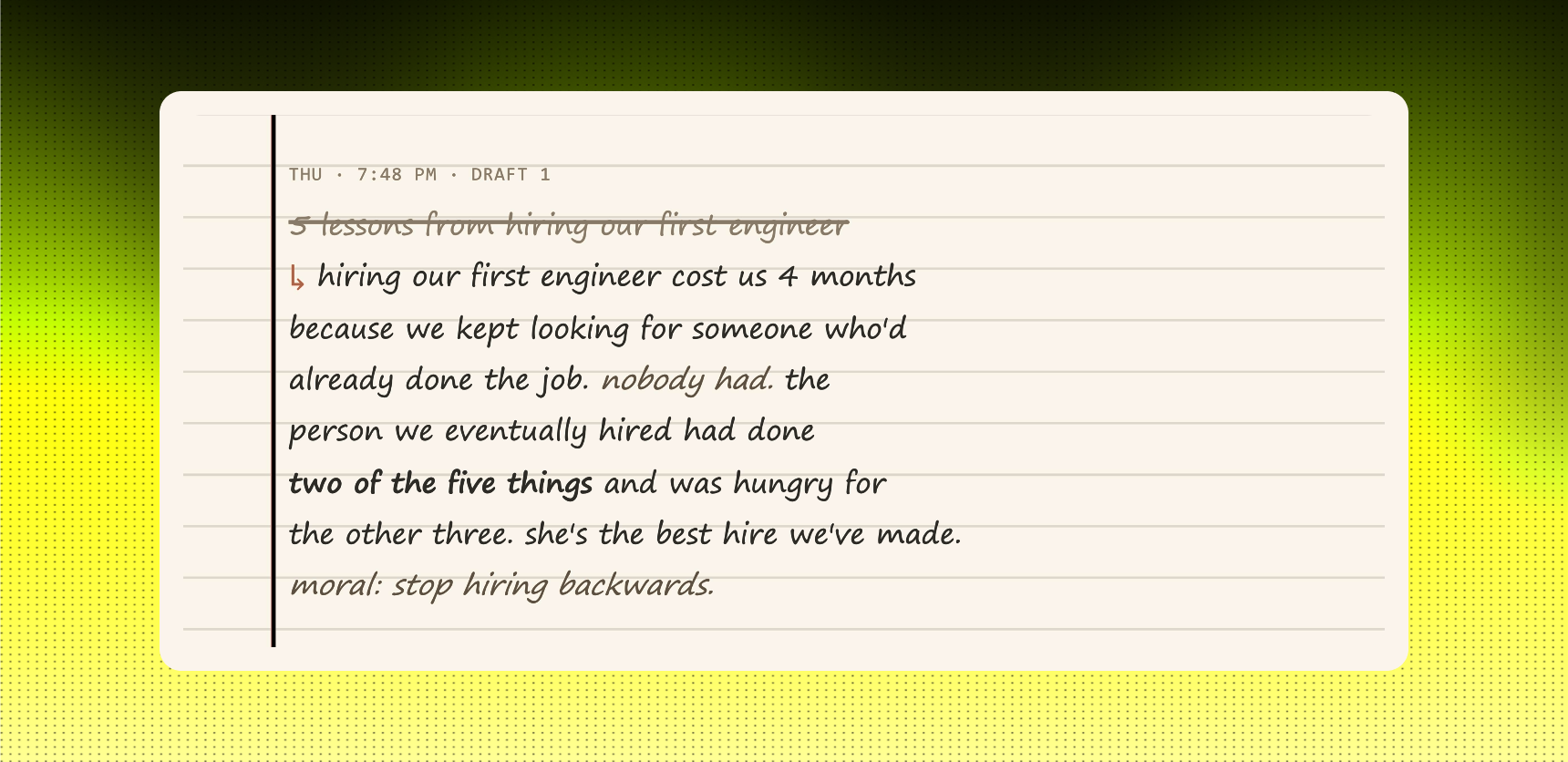
Example: DRAFTING A POST ABOUT HIRING
You ask yourself: "What is the one thing I learned this week that I would tell a friend over coffee?"
STRENGTHS
- It removes the generic AI voice, so the post has your texture rather than a template's.
- The thought must survive your own handwriting before anyone sees it.
- Content compounds because it is genuinely yours; people remember the author.
LIMITS
- It will not help you post every day. The volume drops on purpose.
- It is harder on days when you have nothing to say. That is a signal, not a flaw.
- It does not apply to scheduled, operations-heavy content. Reserve it for posts with your name on top.
Use this when: the post is under your name and is meant to represent how you think, rather than promote, announce, or summarize something.
MOMENT 04 · THINK
One uninterrupted page on what you're actually trying to do.
A weekly page no one else will ever read.
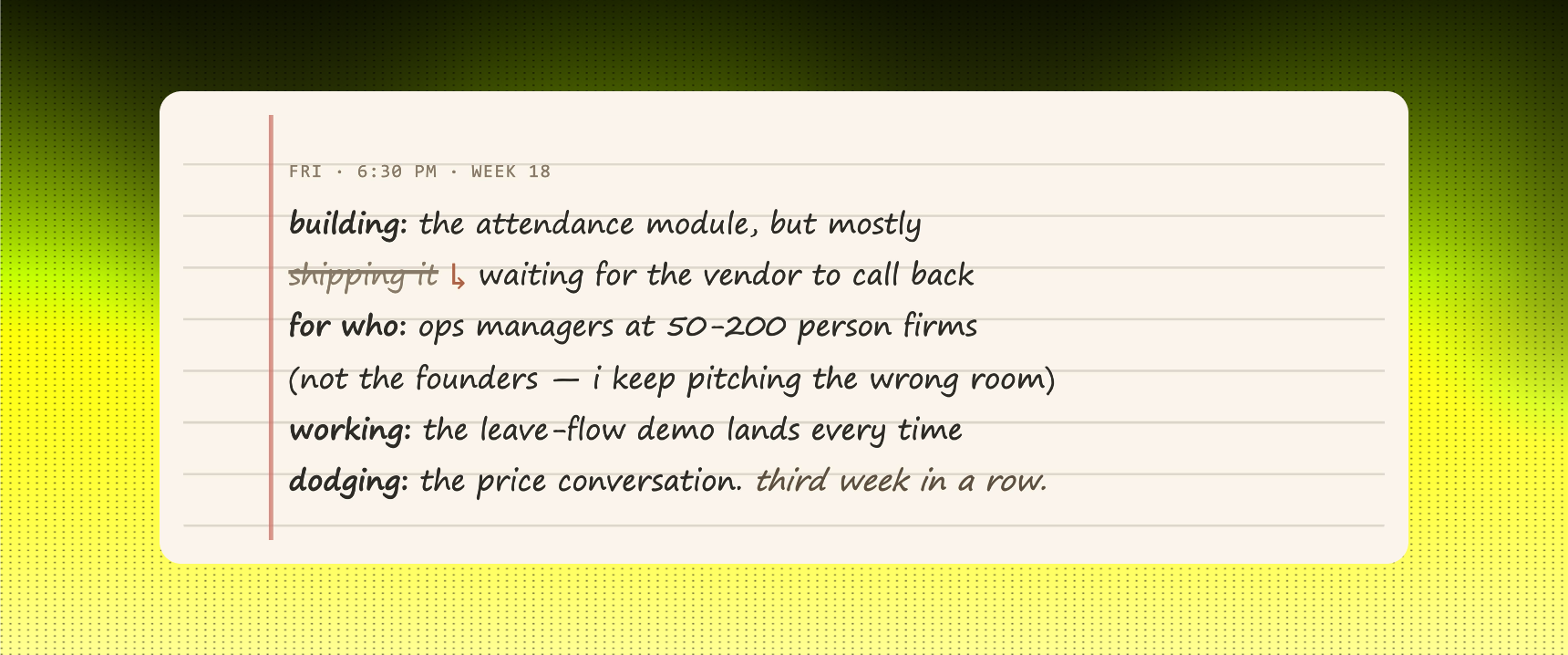
The other three moments are reactions to a message, a decision, or a draft. This one is the opposite. Once a week, sit with a blank page, no phone, no laptop, and no AI, and write through four questions: What am I building? Who am I building it for? What is actually working? What am I avoiding?
The shortcut: set aside twenty minutes at the end of the week, before planning the next one. Write one page. Keep it private: never publish it, share it, or let AI read it. Its value rises with your honesty.
The first few weeks may feel useless, and the page may look thin. Continue. Around week four, the same answer starts appearing in three places, and you find the thing you have been avoiding admitting to yourself. That is the point.
Example: END-OF-WEEKS, FOUR PROMPTS
You ask yourself: "If I am going to be honest with one person this week, let it be the page."
STRENGTHS
- It catches drift early, when the work begins sliding away from the actual goal.
- It recovers your own signal from a week of other people's noise.
- It rebuilds your point of view instead of letting you inherit the feed's.
LIMITS
- It feels pointless during the first three or four weeks. Continue anyway.
- An urgent Friday can easily displace it. Defend the twenty minutes.
- It does not help if you write what you would want a teammate to read. Write for yourself.
Use this when: the week ends and you are unsure what you actually done - or, worse, you are sure, but the answer is not honest yet.
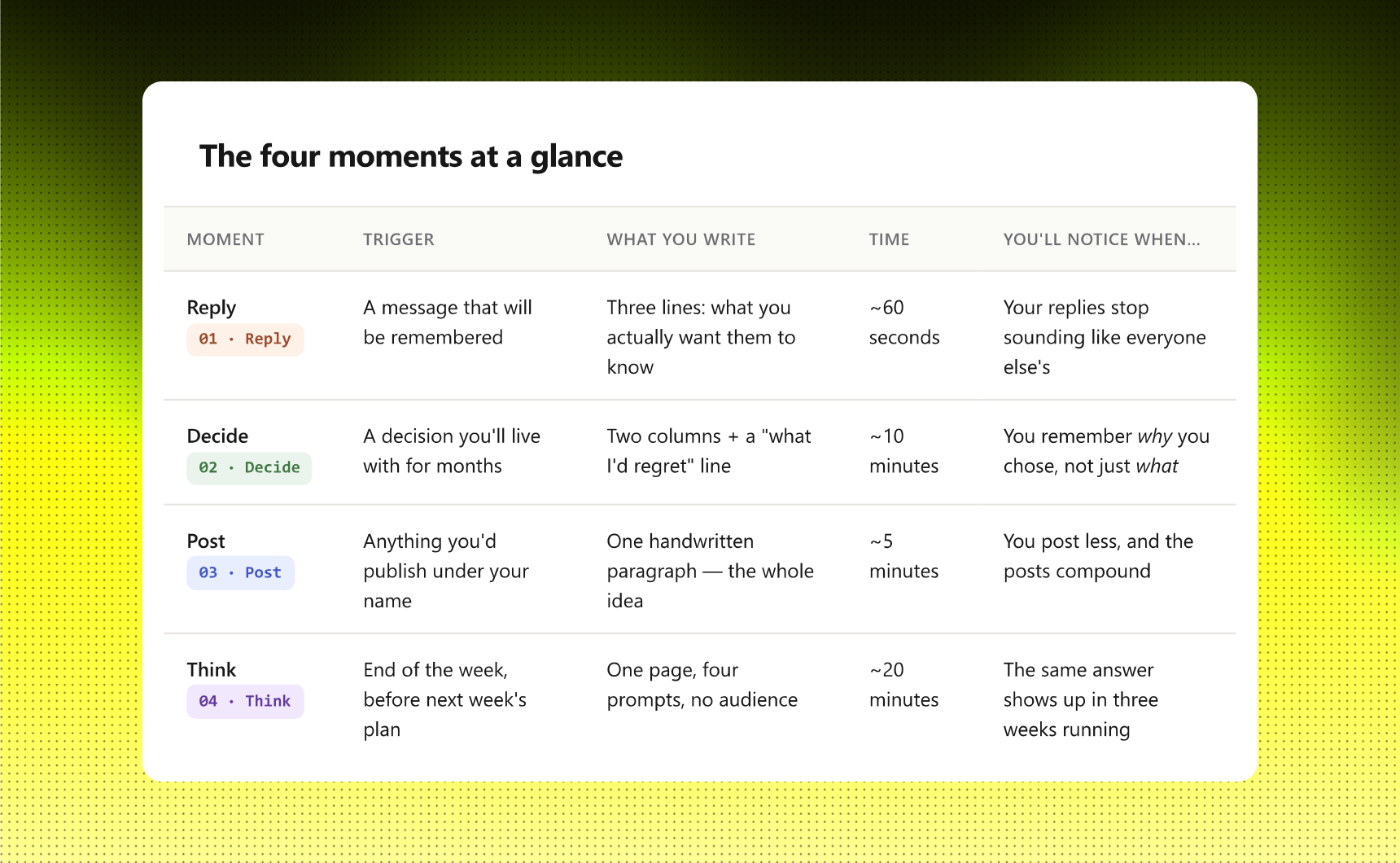
The four moments at a glance
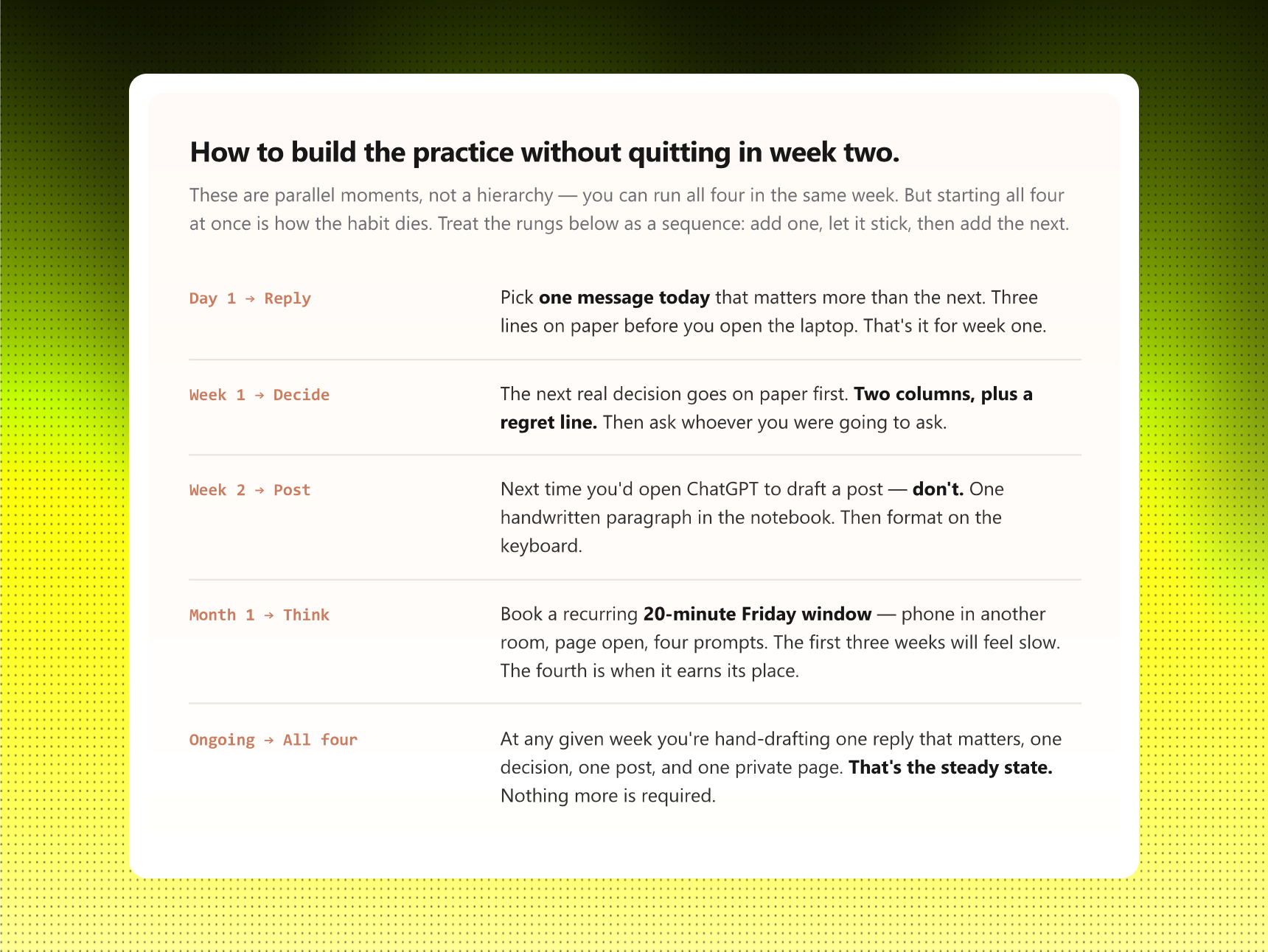
How to start.
Do not try all four at once. Pick the one your week needs most. If your replies have gone flat, start with Reply. If a decision has remained unmade for a week, start with Decide. If your posts sound like everyone else's, start with Post. If you genuinely do not know what you accomplished this week, start with Think.
Buy an inexpensive notebook and a pen you enjoy using. The pen matters more than the notebook: if the pen is uncomfortable, you will quit on a Tuesday. If the page is uncomfortable, you can simply turn it.
Keep the bar low. A poor handwritten sentence is better than a polished AI paragraph that was not yours. The goal is not to produce better writing on the page. It is to produce better thinking away from it.
Writing by hand is not nostalgia. It is the least expensive tool you own for keeping your thinking your own.
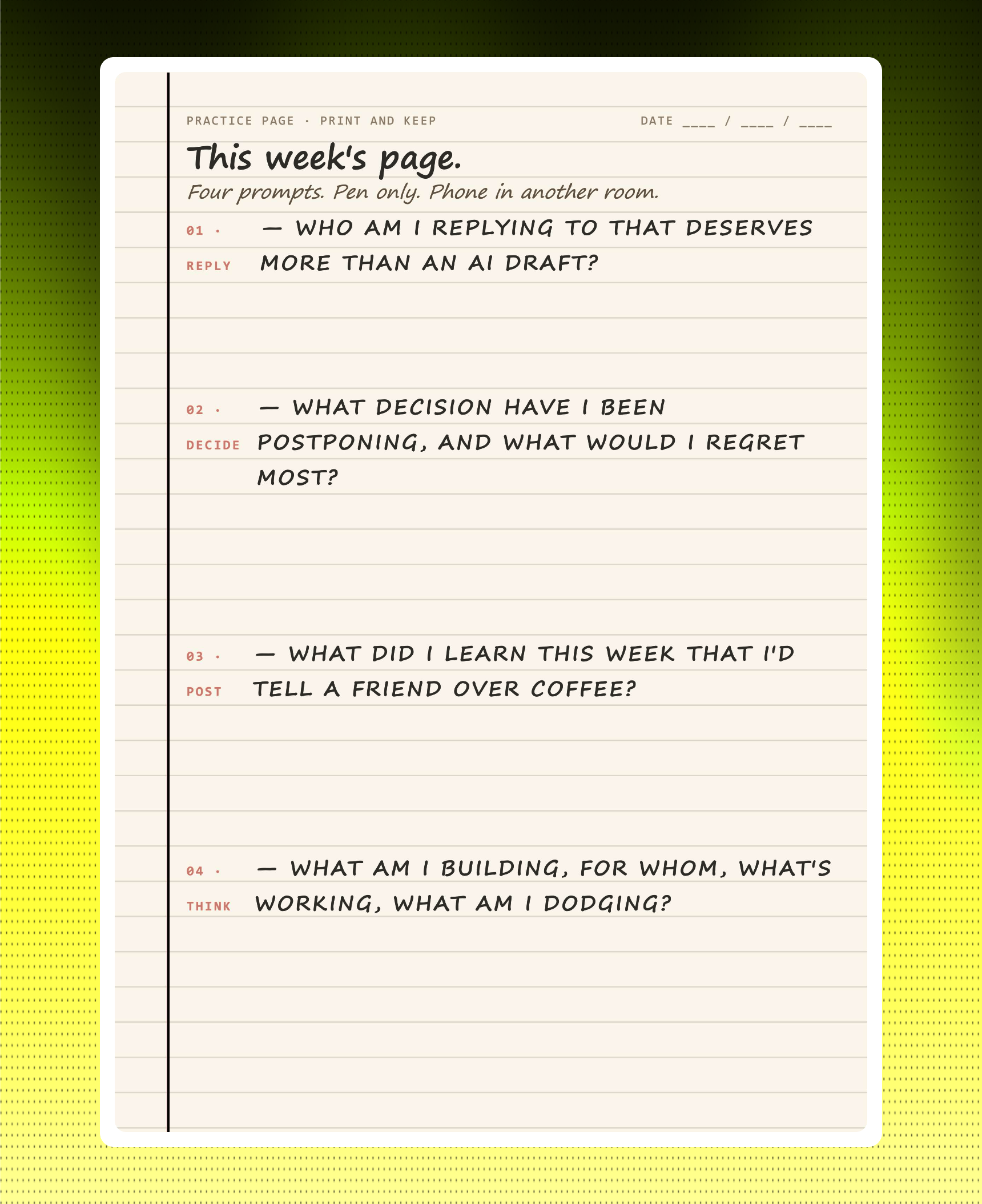
Practice page