
The Task Audit
By Zeel Jain
How to figure out what AI should and shouldn’t do on your team, without finding out the expensive way.
The Task Audit.
How to figure out what AI should and shouldn’t do on your team, without finding out the expensive way.
Most people get the AI question wrong on the first try. They ask which roles to replace. The right question is which tasks within a role to hand over and which to keep close.
THE REFRAME
AI doesn’t replace roles. It replaces tasks within them.
Most teams approach AI by asking which jobs it can take over. That framing is what gets people in trouble. Every role is made of tasks, some repeatable and judgment-light, some the opposite. Mix them up and you end up with output that’s faster but quietly worse, and you don’t catch it until the cost has compounded.
The unit of automation is the task. Not the person.
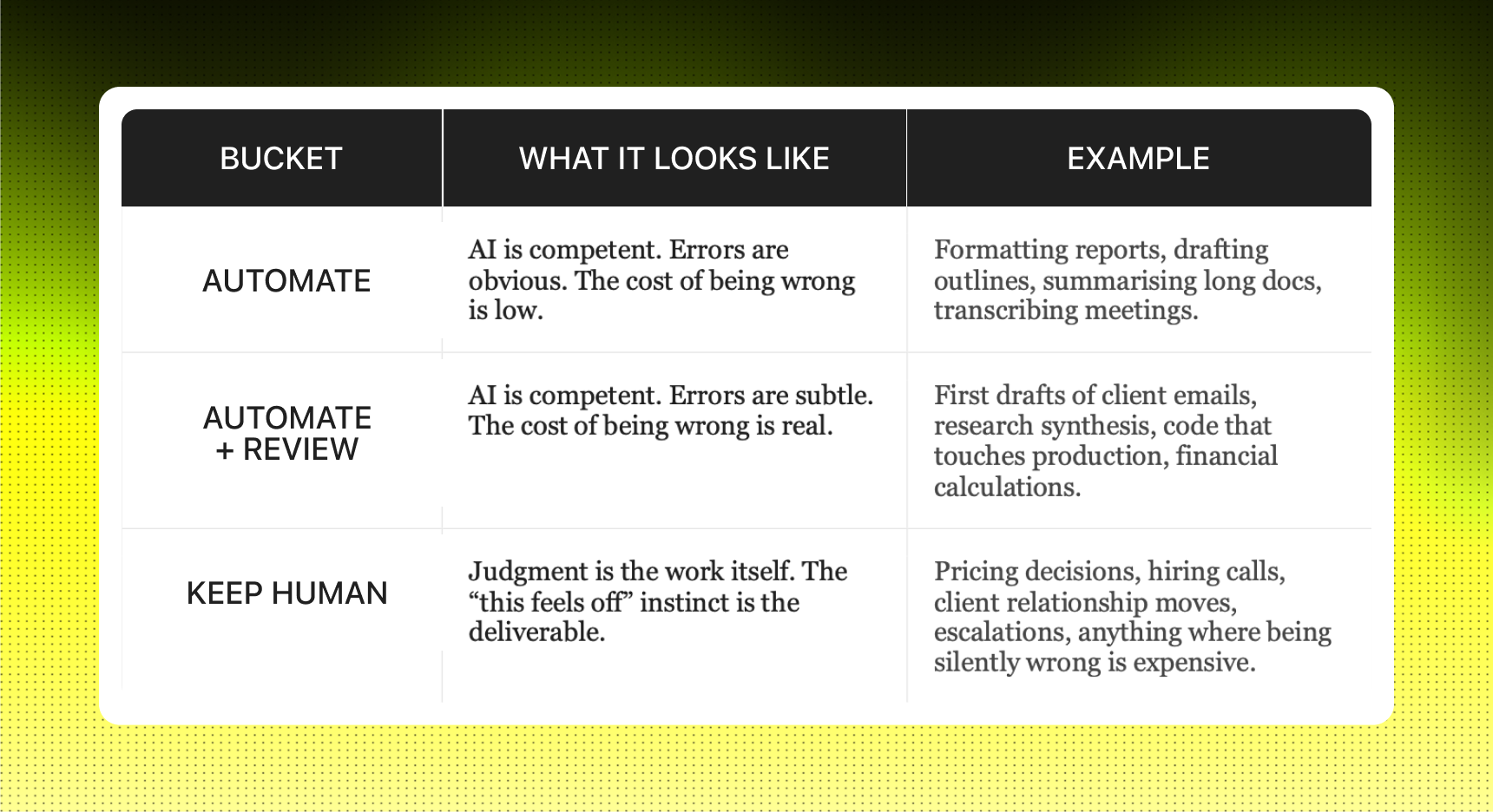
THE THREE BUCKETS
Sort every task in the role into one of these:
THE AUDIT
Three questions that sort any task in under a minute.
01 Can AI produce a competent first version of this?
02 If AI did it wrong, would you notice at a glance?
03 What’s the cost of catching the mistake a week late?
If you can’t answer all three quickly, that task isn’t ready to be handed over yet.
WHAT TO KEEP HUMAN
The 20% that actually needs a brain.
After you sort, look at what’s left for the human. That’s not a smaller job, that’s a sharper one. The judgment calls. The “wait, this doesn’t seem right.” The taste decisions. The work where being slightly wrong is more expensive than being slow.
That’s the part the AI bros don’t talk about. They sell you the speed. They don’t mention the watching.
Smaller team, faster output, but someone still owns the quality, and that someone is now spending their hours on work that actually pays for itself.