
The Judgement Audit
By Zeel Jain
Pattern work versus judgement work; and how to tell which is actually your job.
FOR THE FOUNDERS WHO FEEL BUSY ALL DAY AND BEHIND BY FRIDAY
The Judgement Audit.
Pattern work versus judgement work; and how to tell which is actually your job.
Most days feel productive because you cleared things. Emails answered, reports filed, follow-ups sent. By Friday, the call you actually needed to make is still open.
This is the audit that tells you why.
THE FRAME
Two kinds of work.
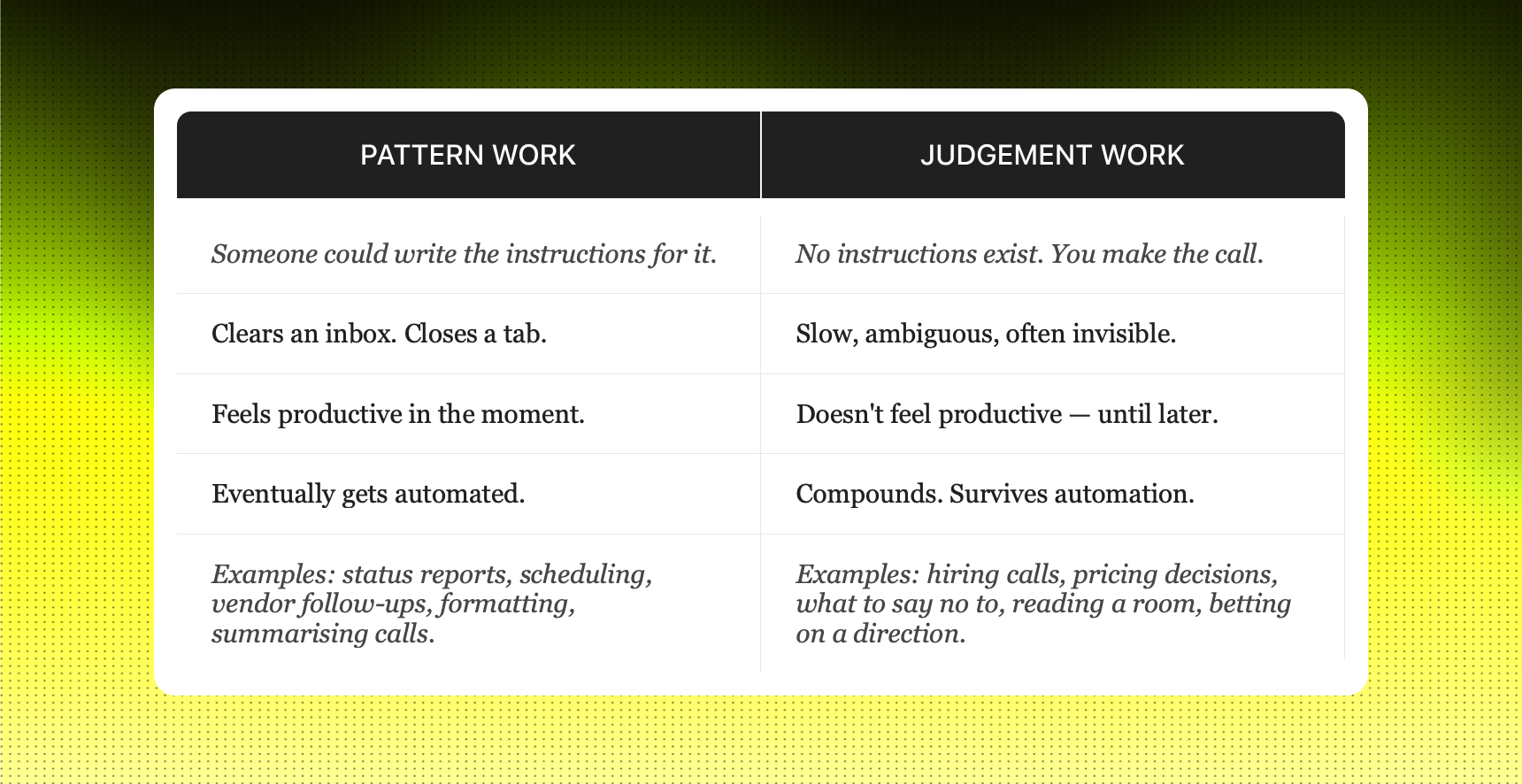
Pattern work is anything someone could write you instructions for. The instructions might be long. They might be subtle. But if a clear-headed person could write them down, the work is patternable, and eventually it gets automated.
Judgement work is what happens when no instructions exist. Reading a situation. Making a call you weren't taught. Seeing something nobody flagged. It's slow, often invisible, and it's the only work that compounds.
The whole game is shifting your hours from the first kind to the second. That's it.
THE TRAP
Why busy feels like the job.
Pattern work feels like progress. Inbox to zero, brief sent, deck approved. Each one is a small hit of completion. Judgment work doesn't give you that, you can spend two hours on a single decision and have nothing to show for it but a slightly different tilt to next week.
So the day fills up with what feels productive. The actual job gets whatever's left, which is usually not much.
That's the trap. The work that makes you feel busy is the work that's eating the work that actually matters.
THE AUDIT
Run this on your last seven days.
Pull up your calendar and your sent folder. Every recurring meeting, every email thread, every project you touched. Don't filter. List it all.
Now mark each one with a single letter:
P · Pattern. Someone could write the instructions for this.
J · Judgement. Only you could have made this call.
? · Honestly, you're not sure. That's a category. Don't force a P or J.
Don't lie to yourself. The first time most founders do this, 70 to 80% of their week sits in the P column, with a sprinkle of J done before 9am or after 9pm.
That ratio is the entire problem. Not the workload. Not the team. Not the calendar. The ratio.
WHAT TO DO
Two columns. Two moves.
The P column · hand it off
Anything in the P column is a candidate for delegation: to a tool, a teammate, or Claude. The question isn't "is this important?" The question is "is this only doable by me?"
For most P-column items, the answer is no. Hand them off, even imperfectly. The first time you delegate a pattern task to Claude, the output won't be as good as yours. Two iterations later, it will be. Six iterations later, you'll forget why you ever did it yourself.
The J column · protect it
Block it on the calendar. Treat it the way a surgeon treats their operating window; uninterruptible, not optional, prioritised over everything that feels more urgent.
Most of the people you admire are not better at executing pattern work than you. They're better at not letting it eat their judgement hours. That's the whole gap.
ONE LAST THING
This won't fix anything by itself.
The audit doesn't change your week. It just shows you the gap between what feels like the job and what is. Once you've seen it, you can't unsee it.
That's the only useful thing about it. The change comes after, when you start saying no to a pattern task that used to feel necessary, and using the time it freed up to make a call you'd been avoiding.
Busy feels like the job. It isn't.