
Stop learning AI. Start using
By Zeel Jain
Four real problems you're already sitting on this week, and the prompts that turn each one into a ten-minute move with Claude or ChatGPT.
Stop learning AI. Start using
Four real problems you're already sitting on this week, and the prompts that turn each one into a ten-minute move with Claude or ChatGPT.
4
Moves you can run today
10 min
To first useful output
0
Tutorials required
Preparation is the most expensive form of procrastination.
The gap between people getting ahead with AI and people watching them is not intelligence. It is not technical skill. It is the willingness to open the tool and give it a real problem from this week.
There is a loop almost everyone gets stuck in. "I need to learn more before I start." Another course. Another tutorial. Another saved thread of prompts you'll get to on Sunday. None of it is preparation. All of it is fear wearing the costume of progress.
Courses teach you a tool in the abstract. Abstract knowledge does not compound. What compounds is the moment you hand the tool an actual decision you owe by Friday: a quote, an email, a model, a call and watch what comes back. That output is usually seventy percent there. The thirty percent on top is yours to add. The doing is the learning.
The shift: stop reading about AI on the train and start running it on the problem you've been avoiding since Monday. The first output is rarely the finished thing. It is the head start that finally lets you finish.
MOVE 01 · PRICING
The quote you've been avoiding.
Brief in, defensible price out.
"What should I charge?" eats more founder and freelancer hours than the work itself. The number sits open in a draft for three days while you ask Twitter, scroll a pricing course, and stare at your last invoice for clues. The client is waiting on a single email. You are losing the gig to the person who replied the same evening.
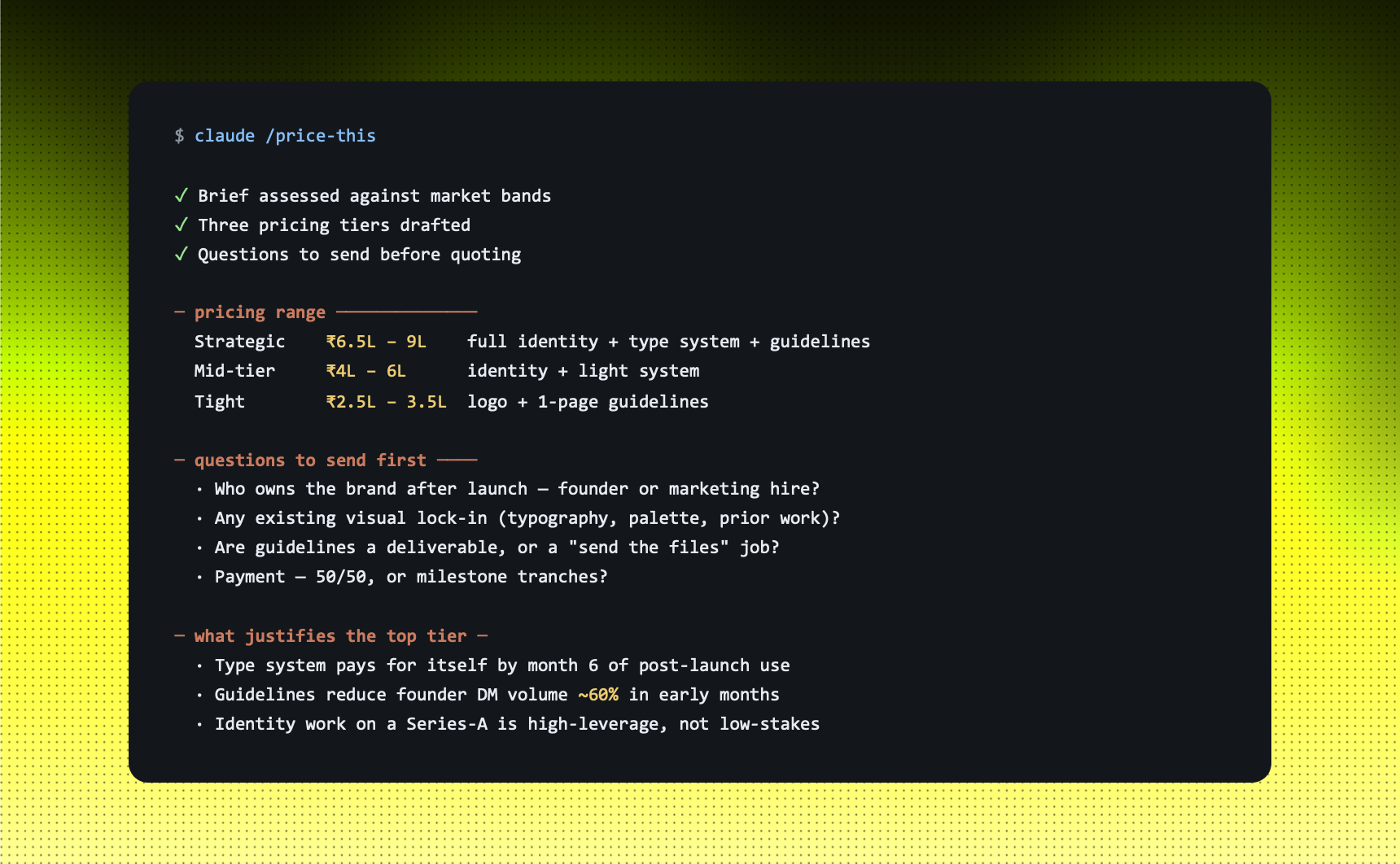
The shortcut: paste the full brief: scope, your experience, the client's stage, the timeline. Ask for a defensible range, the questions to send before quoting, and the line that justifies the top of the band. You get a quote-ready answer in the time it takes to make coffee.
Example: BRAND IDENTITY FOR A FINTECH, ~6 WEEKS
You ask Claude: "I'm a brand designer, 5 years in. Just got asked to redesign a Series - A fintech's identity: logo, type system, guidelines, ~6 weeks. They want a quote. Help me price it without lowballing or scaring them off."
STRENGTHS
- Ends the analysis paralysis, you get a range, not a guess.
- Surfaces the qualifying questions you forgot to ask before quoting.
- The "what justifies the top tier" section becomes your pitch language.
LIMITS
- Doesn't know your local market or your reputation premium.
- Can't read the client's body language, that's still your job.
- Numbers need a final pass before they go in the email.
Use this when: a quote is due and you've been staring at a blank email for more than a day.
MOVE 02 · OUTREACH
The email you've rewritten six times.
Context in, sendable email out.
Cold emails, follow-ups, hard conversations, they die in the draft folder. Not because you don't know what to say, but because the blank page is the worst place to start. You rewrite the first sentence six times. You close the tab. You promise to do it tomorrow. The thread cools. The opportunity drifts.
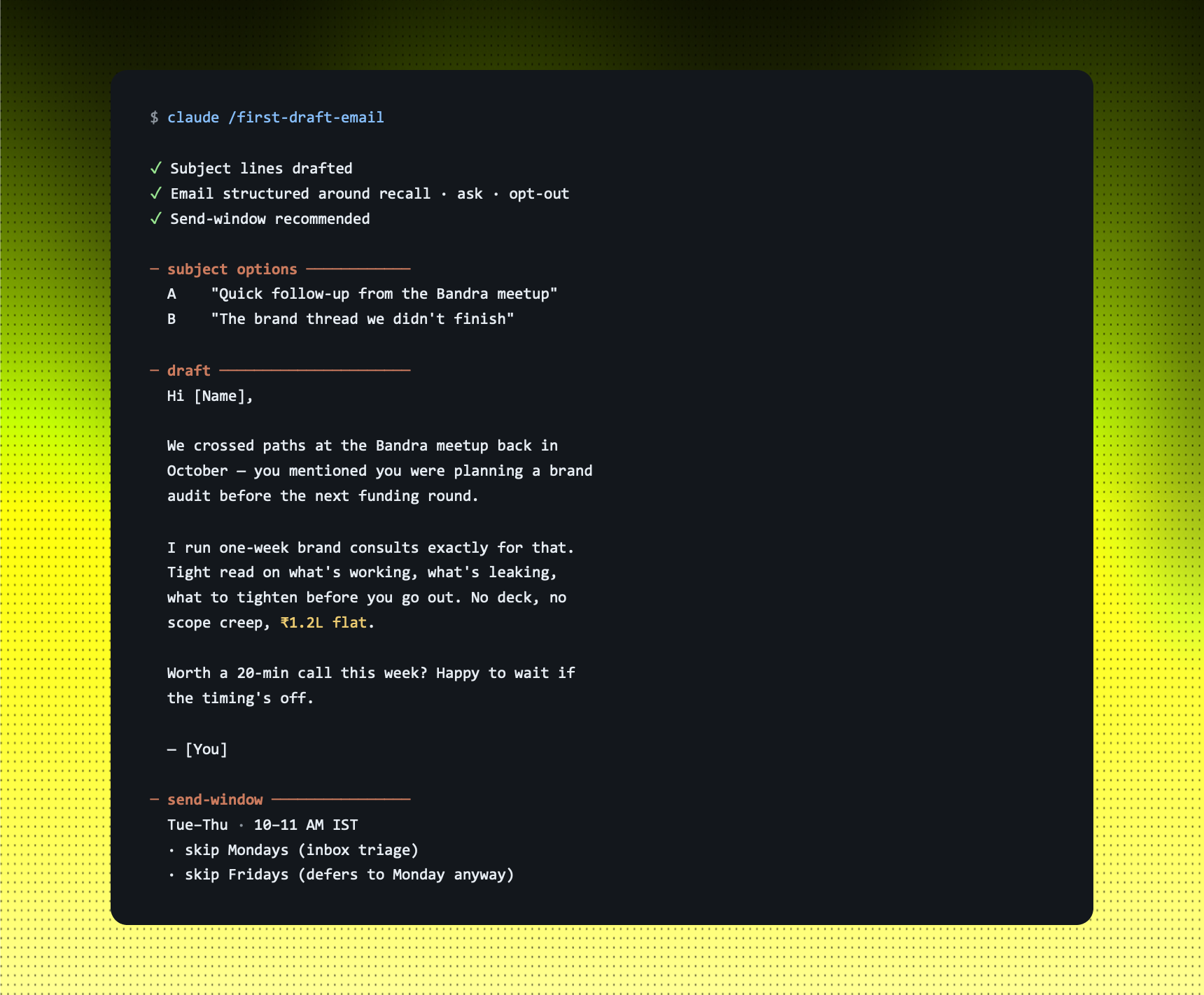
The shortcut: hand the AI everything you'd tell a colleague before they wrote it for you, who, history, the ask, what you want to leave them with. You get a clean draft, two subject options, and a send window. Edit for voice, send, get on with the day.
Example: COLD-WARM REACH-OUT, SERIES-A HEAD OF DESIGN
You ask Claude: "I need to email the Head of Design at a Series-A company. We met briefly at a meetup six weeks ago. I want to pitch a one-week brand-audit consult. Write the first email."
STRENGTHS
- Kills the blank-page problem, you get something to react to.
- Structures the ask cleanly: recall, value, opt-out.
- Subject lines you'd never have written under pressure.
LIMITS
- Voice needs your edit pass, the draft sounds slightly generic by default.
- Doesn't know what was already said between you. Feed it the prior thread.
- Hard conversations still need your tone on top of the structure.
Use this when: It's been three days and the message you owe is still in drafts.
MOVE 03 · NUMBERS
The model you keep starting over.
Inputs in, working projection out.
Financial models are ninety percent structure and ten percent judgement. The ten percent is yours. The ninety percent is the part you keep restarting at midnight because the empty spreadsheet won't tell you which cells matter. Most people never get past the column headers.
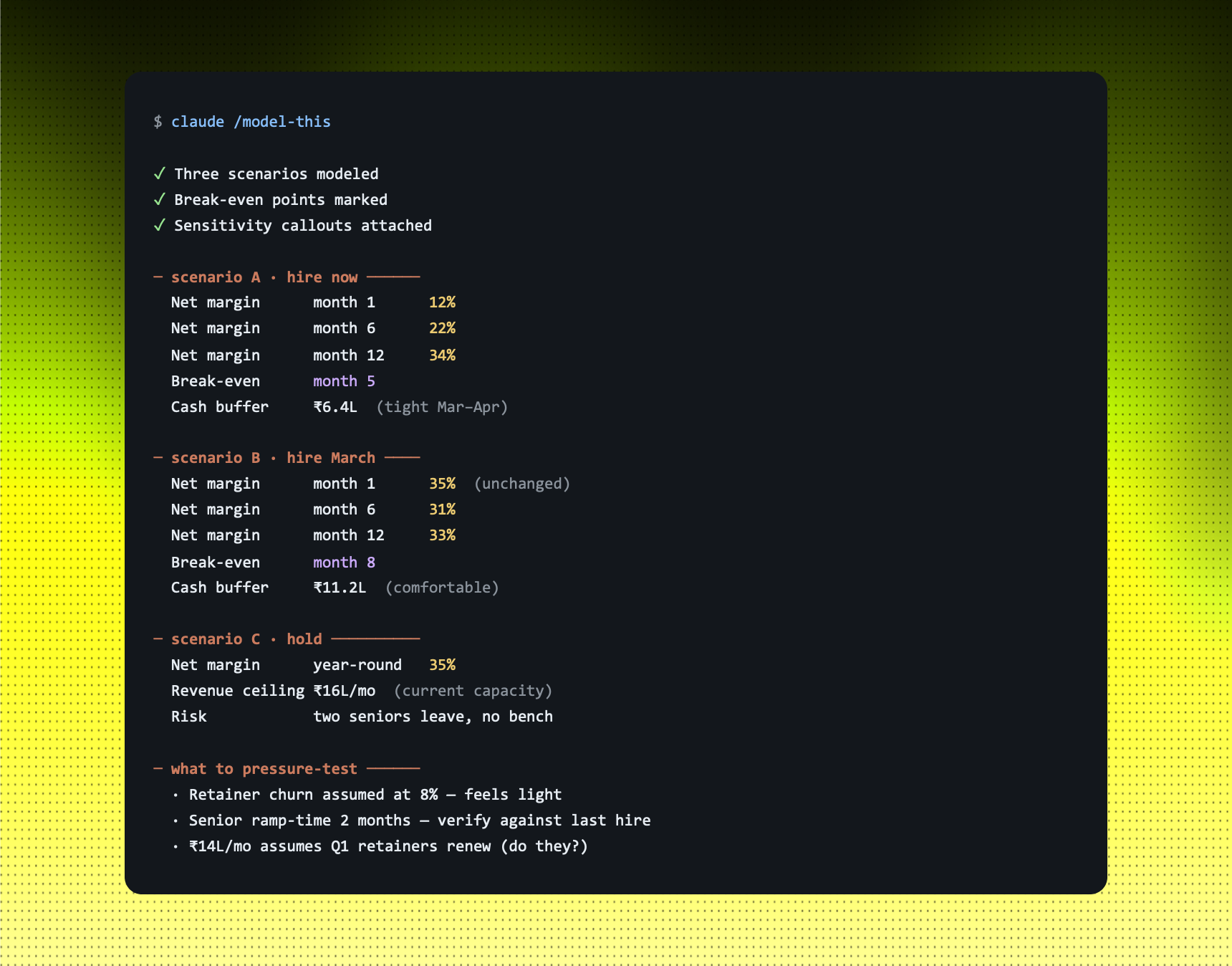
The shortcut: hand the AI your real numbers, current revenue, margin, the scenarios you're weighing, and ask for a twelve-month projection across the options. You get a side-by-side, break-even points, and a short list of what to pressure-test. The structure is solved. Your judgement goes into the assumptions, not the layout.
Example: 4 - PERSON STUDIO CONSIDERING TWO SENIOR HIRES
You ask Claude: "I run a 4-person design studio. ₹14L/mo revenue, ~35% margins. Considering hiring two senior designers at ₹1.1L each. Build a 12-month projection, hire now vs hire in March vs hold."
STRENGTHS
- Ends the empty-spreadsheet stare, structure arrives in minutes.
- Surfaces scenarios you forgot to weigh.
- The "pressure-test" list is the one a good CFO would write.
LIMITS
- Hallucinates on tax and regulatory edges, verify these separately.
- Assumptions are guesses dressed as confidence. Own them yourself.
- Garbage in, garbage out, your inputs need to be real.
Use this when: a decision hinges on numbers: a hire, a price change, a runway call, and you can't picture the next twelve months.
MOVE 04 · JUDGMENT
The decision you've been postponing.
Context in, framed call out.
Most "I need more information" actually means "I am scared to decide." The information you've already gathered is usually enough. What's missing is the frame: the way of laying the choice out so the right question becomes obvious. That's the part you keep delaying because it requires sitting with the discomfort.
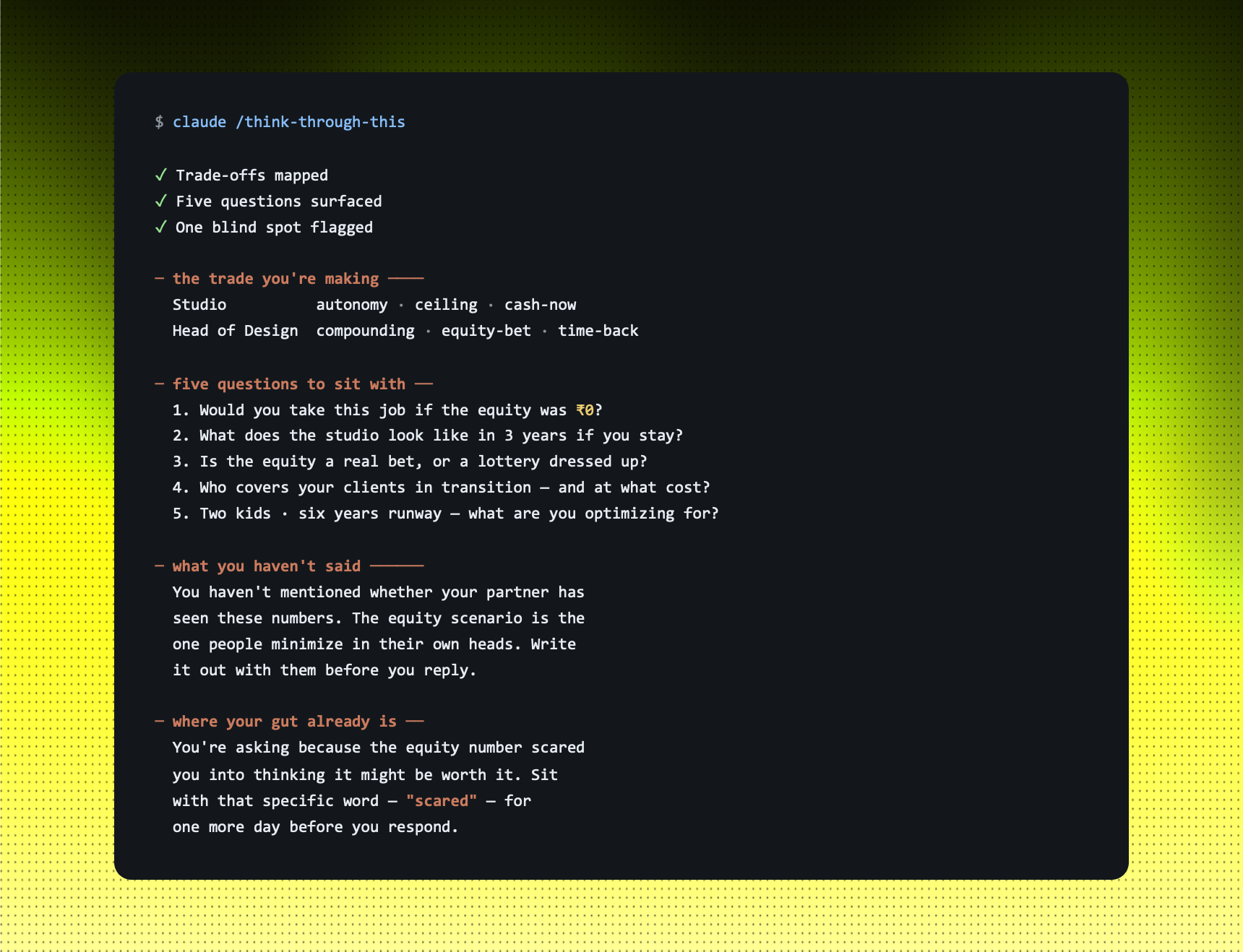
The shortcut: hand the AI the full context, the options, and your gut lean. Ask it to map the trade-off, surface the questions you haven't asked, and flag what you're avoiding. It won't make the call. It will get you to the call faster, which is the only part of this that was ever the bottleneck.
Example: JOB OFFER, FOUNDER WEIGHING A HEAD-OF-DESIGN ROLE
You ask Claude: "I've been offered Head of Design at a Series-B SaaS. ₹38L cash + 0.4% equity. I currently run my own studio doing ₹18L/mo profit. I'm 33, two kids, six years runway. Help me think through this."
STRENGTHS
- Maps your blind spots, the questions you've been routing around.
- Counters your favourite narrative, gently.
- Surfaces the question your gut already had but couldn't name.
LIMITS
- Doesn't know your risk tolerance, only you do.
- Can't replace the conversation with your partner or co-founder.
- The final call is still yours. The frame is the gift, not the answer.
Use this when: you've been "thinking about it" for more than a week and the thinking is no longer producing new information.
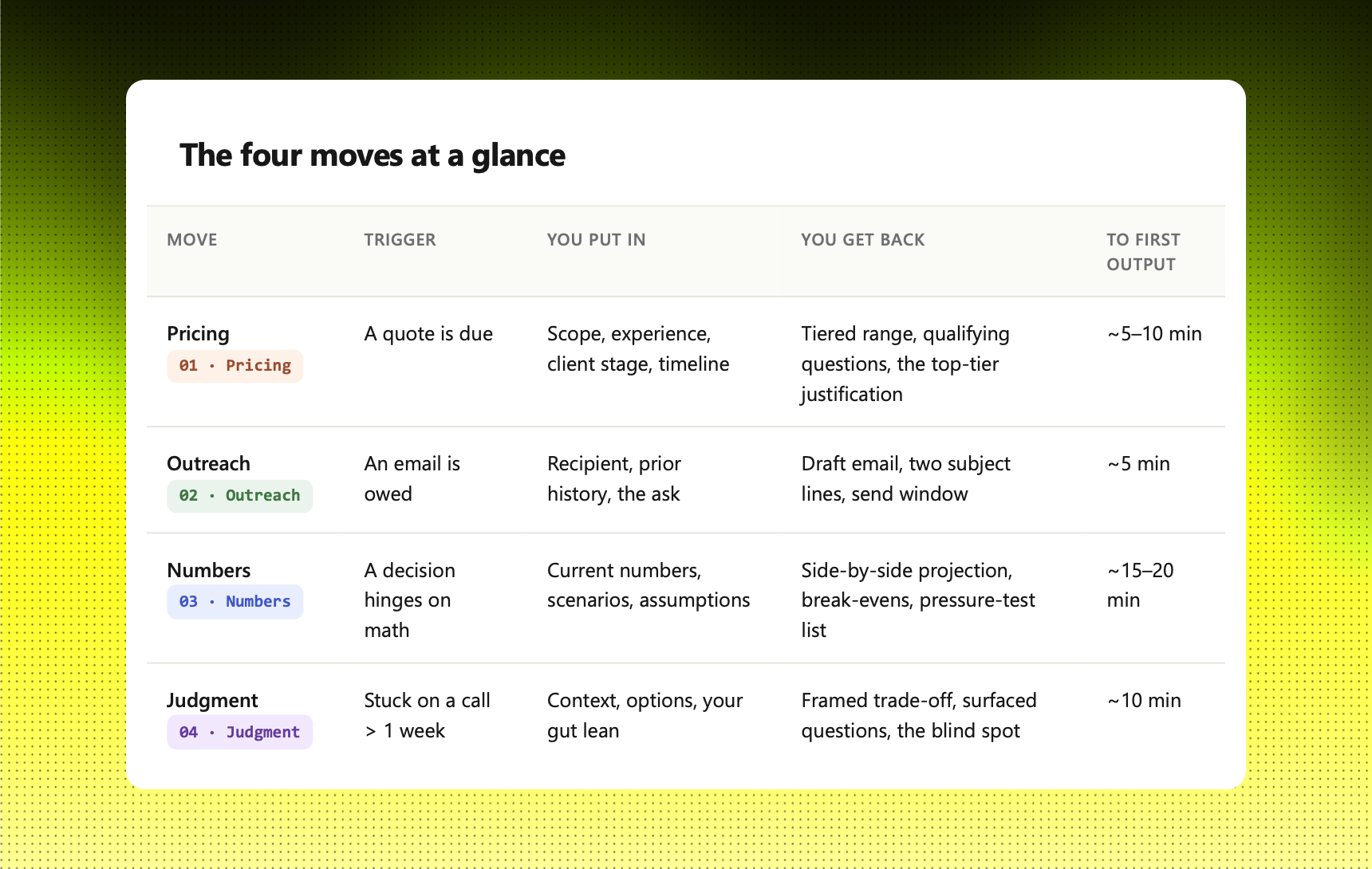
The four moves at a glance.
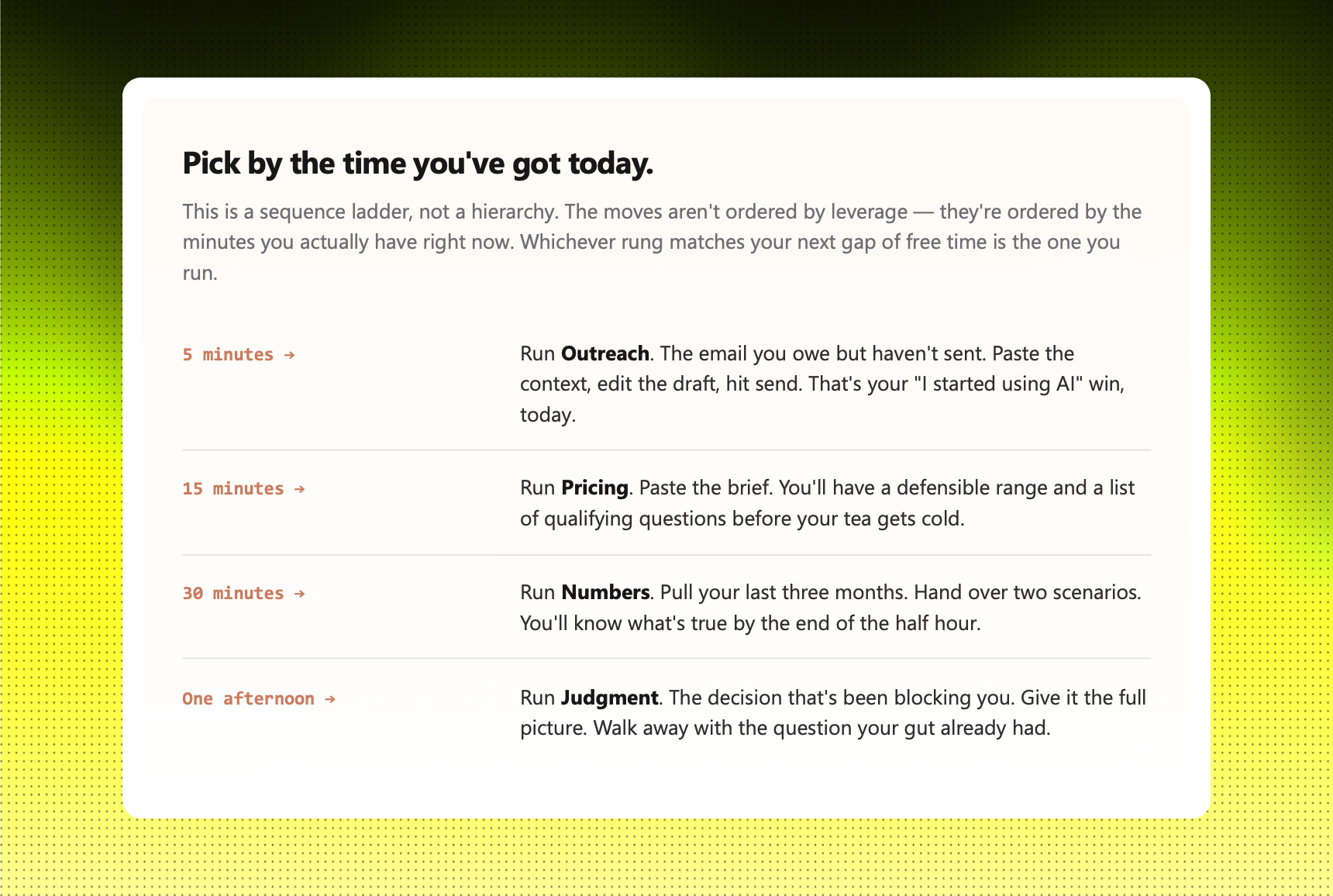
How to start.
Pick the move that's already nagging you. Not the one with the highest leverage on paper, the one you've already half-drafted in your head this week. Run it on the actual context. Don't sanitize the inputs. Don't pretend it's hypothetical. The first output is the head start, not the finished thing.
The first output will be seventy percent there. The remaining thirty percent is the part that makes it sound like you, not the model. That edit layer is where your judgement lives, and it's the only part of this work you can't outsource. Notice what you change. The changes are the signal.
Don't bookmark this. Don't promise to come back to it tomorrow. The people who pulled ahead with AI in the last year didn't have a better tool or a smarter prompt. They opened it, fumbled through a real problem, and now can't imagine working without it.
Close this tab. Open Claude. Give it something real.